


The Ultimate Coliving Stakeholder: Understanding Demand for Optimal Product Market Fit
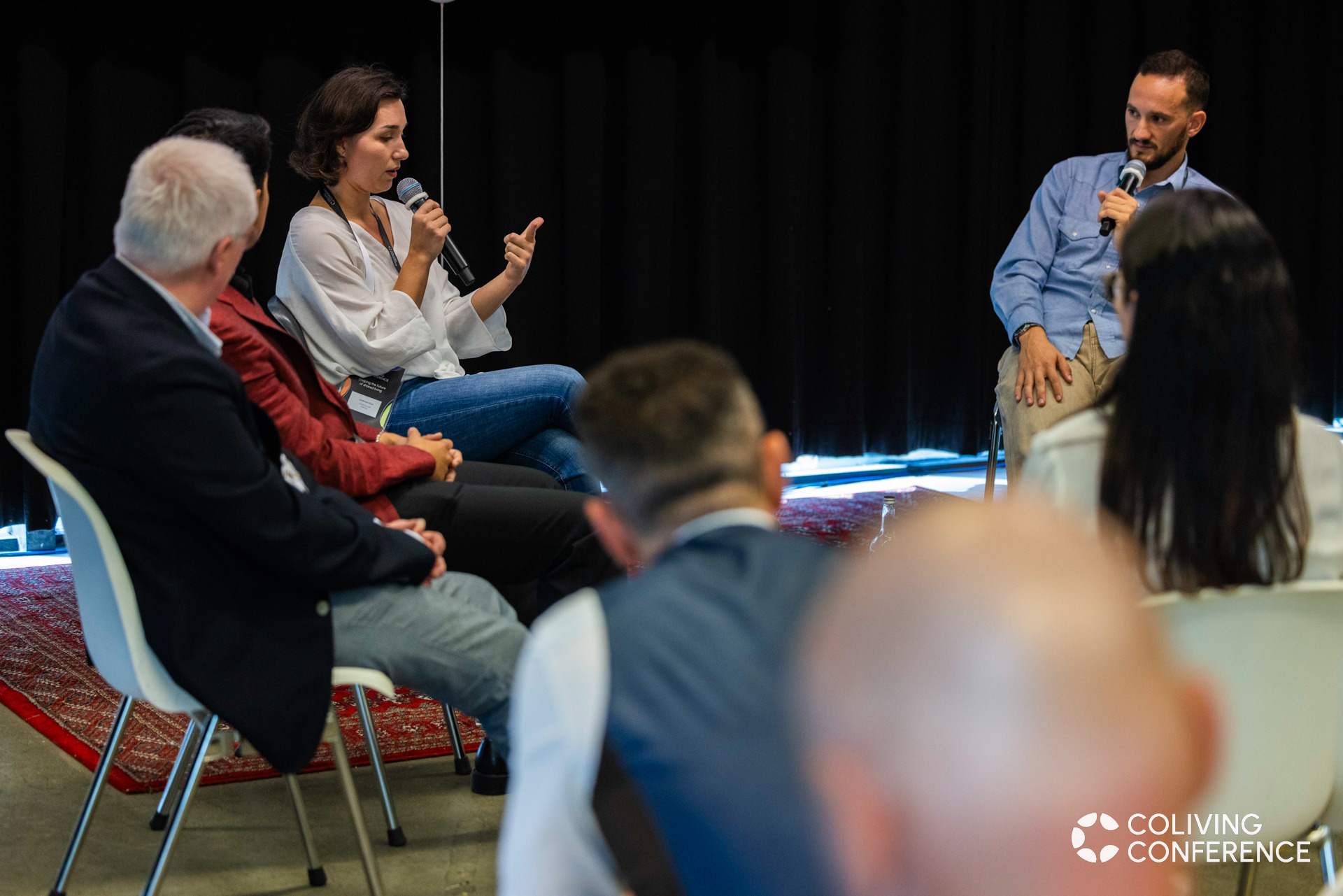
The Coliving Conference 2024 featured a thought-provoking fireside chat with two coliving professionals who have lived the coliving experience firsthand and now work within the industry. Andreea Rusu and Kyle Gaarder shared their unique journey from residents to professionals working alongside operators and industry hubs provided a valuable perspective on how coliving spaces can evolve to better serve the needs of their communities.
Coliving’s promise has always sounded straightforward - offer flexibility, belonging, and a better use of space in cities where traditional housing feels increasingly out of reach. Yet the lived reality is more complex. The strongest communities do not simply emerge because a building has a shared kitchen and a calendar of events, and the most “efficient” operations do not automatically create the depth of connection that residents secretly yearn for. The sector is now confronting a question that goes beyond occupancy and branding - how can coliving be designed and run as a scalable business without sanding off the human edges that make it worth choosing in the first place?
Insights shared at the Coliving Conference 2024 in Amsterdam, The Netherlands, captured that tension in a refreshingly grounded way, not through grand proclamations but through resident-centred stories about chaos, care, burnout, onboarding, and the quiet craft of helping strangers become a functional micro-society. The lesson for the industry is that product market fit in coliving is not found only in unit mix and location strategy. It is found in the operating model’s stance on responsibility: who holds it, how it is shared, and what happens when real life arrives at the front door.
Is Community an Amenity or the Core Offer?
Some coliving players often treat community like a feature, alongside wifi speed and cleaning standards. Resident experience suggests the opposite. When coliving works, community is not an add-on. It is the product’s differentiator, the reason people accept compromises such as smaller private space or more negotiation over shared norms.
Kyle Gaarder, Researcher & Coliving Community Manager, early experience in Portland highlights how residents interpret that proposition when it is taken seriously. In a long-stay home of around 10 to 20 people, with typical stays of one to two years, the community operated with minimal formal hierarchy and significant resident involvement. New members were funnelled by the operator, yet the household interviewed and decided who joined, shaping culture as much as any brand guidelines could. That level of stewardship made the home feel genuinely owned by residents even though it was a rental arrangement, and it reveals an important truth - belonging is difficult to outsource. When residents participate in selection, rituals, and shared decisions, they invest emotionally, and the return is resilience and identity rather than mere satisfaction.
Yet this model also exposes a strategic trade-off. Gaarder later observed that what can feel empowering for residents can be “financially terrifying” for an operator. Empty rooms can erase already thin margins, and requiring community consensus for every intake decision can slow sales velocity in a way that is incompatible with many cost structures. The implication is not that resident-led selection is unworkable, but that operators must design mechanisms that protect occupancy while still giving residents meaningful influence. This can be achieved through structured inputs, time-boxed interviews, or culture-fit guardrails rather than full veto power. Product market fit depends on acknowledging that community and cash flow are interdependent, not competing priorities.
How Much Structure is Too Much?

Coliving attracts many people precisely because it promises something more organic than traditional rental living. But organic does not mean structure-free. Gaarder described early self-management as “chaos”, particularly when residents are new to communal living and have not yet built shared habits for conflict, decision-making, or mutual support. His comparison to a toddler raising itself is provocative, but it lands because many coliving operators have witnessed the same pattern - without scaffolding, even well-intentioned residents default to avoidance, misunderstandings, and informal cliques.
Structure should be treated as a lifecycle tool rather than a fixed ideology. Too much management can reduce friction, but it can also reduce ownership. Too little management can enable ownership, but it can also amplify instability. Gaarder’s later reflection that more structure at the beginning, followed by a gradual handover of stewardship as residents stay longer, resembles a maturity model. In practice, that means onboarding residents into shared norms early, formalising basic house processes, and then progressively inviting deeper participation as trust grows. For longer-stay coliving in particular, stewardship becomes part of retention. The longer people live together, the more they want to shape the home rather than simply consume it.
This is also where the industry’s language matters. “Non-hierarchical” can be an inspiring value, yet a home still needs clarity around accountability. The operational design question is not whether hierarchy exists, but whether power is transparent, fair, and aligned with the resident experience the brand is selling.
Operations Need Infrastructure, Not Heroics
Coliving is full of origin stories that celebrate hustle. A landlord takes a chance, a founder moves fast, a first cohort arrives, and the calendar fills. Gaarder’s Austin experience shows both the potential and the cost of this approach. He operated a six-bedroom house with one shared room, housing eight people, and did it as a solo operator for roughly two years. The first residents arrived through a startup accelerator partnership - a smart distribution channel because the cohort already wanted connection and had a clear reason to relocate. From there, the model broadened into month-to-month long-stay coliving, with marketing that relied on relentless outreach and what he called “guerrilla marketing” across the internet.
The cautionary lesson is not that small-scale coliving cannot work, but that relying on operator heroics is not a strategy for scale. Gaarder described a growing sense that the movement lacks shared infrastructure, particularly around lead generation and the fragmented “Frankensteined” stack of tools operators piece together to run homes. For business intelligence leaders, the takeaway is that product market fit will increasingly be shaped by back-end capability. The experience residents value - smooth onboarding, responsive communication, and consistent rituals - depends on systems that free community teams from administrative overload. When operations are under-tooled, the human layer becomes brittle. When the human layer breaks, the brand promise collapses.
Onboarding is the First Community Intervention
Marketing brings people to the door, but onboarding decides whether they enter as guests or as future contributors. Andreea Rusu, Community Management & Marketing Professional, who lived across multiple coliving homes in Europe after leaving her apartment in Bucharest, framed onboarding as the most decisive moment for making people feel “seen” and “heard”. She described welcoming a new resident not only by explaining logistics, but by learning their story, listening to passions, and introducing them to others who share interests before they even fully enter the social stream.
This converts anonymity into identity. In coliving, residents arrive carrying uncertainty - assessing whether the space is safe, whether they will be judged, and whether the promised community is real. A transactional tour produces a transactional resident, while a relational onboarding produces a participant. From a product standpoint, onboarding is the first deliberate act of community design.
Her experience also highlights a broader demand driver that operators should not ignore - affordability and mobility. Her initial move into coliving was enabled by a skills-exchange platform where she contributed social media work in return for staying in a coliving setting. The details underscore that not all demand comes from high-earning digital nomads. Some demand comes from people with remote work flexibility but limited purchasing power, who will trade labour and skills for access to community and travel. For operators, the strategic question is whether and how to create structured “contribution pathways” that maintain fairness, legal compliance, and brand consistency while widening the funnel.
Rituals Make Strangers Cooperative

Many operators already know that dinners work. What is useful in Rusu’s account is why they work, and how they scale from pleasant socialising into a predictable cohesion engine. She described weekly community meetings where residents gather to plan the week, surface needs, and propose activities such as skillshares. These meetings institutionalise voice, while also reducing the emotional load on community staff because residents learn to co-create the calendar rather than wait to be entertained.
She also emphasised themed dinners, playful costume events, and games as tools that give adults permission to drop professional masks. When people play, they disclose, and trust increases. When trust increases, small conflicts are handled earlier and more kindly, and the home becomes more resilient.
Her example of structured reciprocity, where residents write down what they can offer and what they might receive, points to an emerging operating idea - community can be cultivated through mechanisms, not just vibes. Reciprocity formats turn a diverse group into an exchange network, and that network is what keeps residents engaged once the novelty of arrival fades. In business terms, rituals reduce churn risk by making the social value of staying more tangible.
Care, Crisis & the Limits of Community
The industry sometimes over-romanticises community, implying that it can solve any problem. Gaarder’s story of a resident whose life unravelled after bereavement, spiralling into addiction, provides a sobering counterpoint. The home faced repeated emergencies and significant strain. Yet the community responded by creating a WhatsApp support group, coordinating care, and allowing residents to step back when burnt out while others stepped forward. In his telling, the experience was both dark and “beautiful”, not because crisis is desirable, but because it revealed what collective support can look like when people feel responsible for one another.
For decision-makers, this story should trigger operational questions. What are the boundaries of peer support in a housing setting? How should staff be trained to respond when mental health or addiction crises occur? What policies protect both the individual in crisis and the wider community? Coliving cannot replace professional healthcare or safeguarding, yet it can either intensify harm through neglect or reduce harm through early intervention and structured support channels. The strategic move is to design for reality rather than idealism, including escalation protocols, partnerships with local services, and clear behavioural expectations communicated at onboarding.
This is also where regulation and investor risk intersect with resident experience. A home that promises community must also manage duty of care, reputation risk, and liability. The sector’s maturation will depend on how transparently it can address these moments without betraying the warmth that attracts residents in the first place.
Sustainable Coliving is a Team Sport
Both speakers converged on a point that the industry often learns the hard way - coliving operations burn people out when the emotional labour is concentrated. Gaarder eventually closed his Austin operation partly due to burnout and partly because he was pulled towards system-level work rather than running a single house. He also argued that operating successfully needs complementary energies, a blend of head and heart, business and home. Rusu translated that into a practical set of roles - operations management, communication, community building, interior design, and outward-facing bridge builders who connect the internal community to local neighbourhoods and partnerships.
The deeper implication is that coliving’s product market fit is organisational as much as it is demographic. The “ultimate stakeholder” is not only the resident - it is also the operator team that must deliver the experience week after week. If the operating model cannot sustain staff and founders, it cannot sustain residents either. The sector is moving from charismatic pioneers to repeatable organisations, and that shift is essential if coliving is to become a credible part of the urban housing mix.
Where Product Market Fit is Really Won
Coliving’s opportunity right now is not simply that people feel lonely or priced out, although those pressures are real and increasingly visible. It is that the sector is learning to translate human needs into operational choices that can be measured, improved, and scaled.
The resident stories add texture to that agenda. They suggest that operators should treat onboarding as the first conversion moment, invest in rituals that generate reciprocity rather than passive attendance, and design governance that evolves as residents settle in. They also show that crisis readiness is not an edge case, it is part of running homes that contain real lives. Finally, a sustainable coliving business is built by teams and systems, not by exhausted heroes holding the centre.
Coliving has already travelled far from its niche roots, and its next leap will come from combining disciplined operational infrastructure with genuine care. When operators, investors, and developers build for that dual truth, they stop choosing between margin and meaning. They start building homes that can last, and communities that make staying feel like the rational choice rather than a romantic gamble.