


Investment Agenda: Exploring Challenges, Trends, Sentiment, and Indicators Driving Market Dynamics
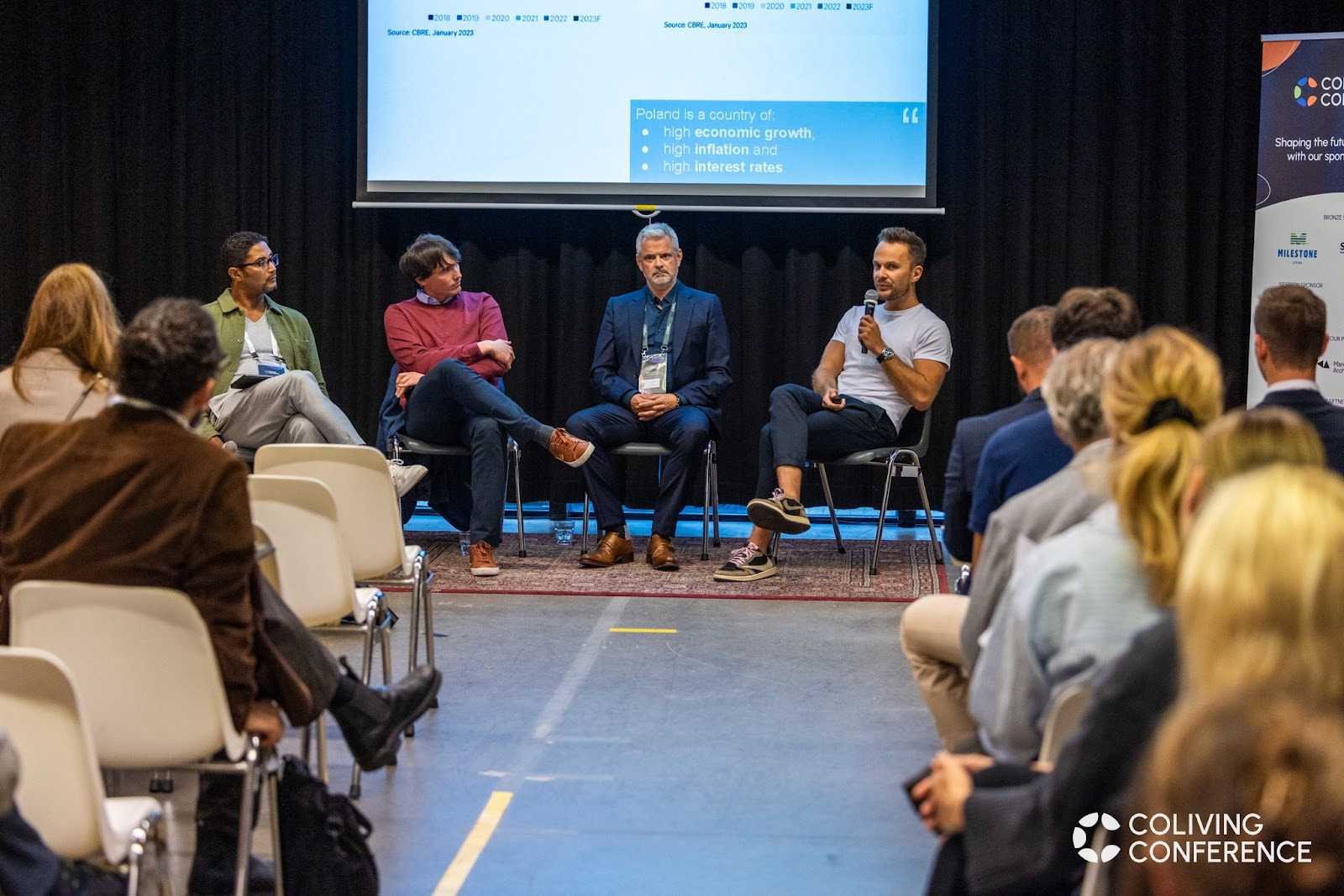
The Coliving Conference 2024 featured a thought-provoking panel discussion about the investment landscape in coliving, including challenges, trends, sentiment analysis, and key market indicators moderated by Williams Johnson. Panelists included Christophe Vercarre, Steve Davis, and Jerzy Lipiński. This session analysed the current financing landscape in the coliving industry, including various funding options and sources of capital for developers and operators, providing valuable insights for investors and industry professionals.
The global conversation surrounding shared living has shifted perceptibly. Investors and operators are now navigating a landscape where the easy wins in capital cities are vanishing, forcing a strategic pivot toward regional hubs, complex adaptive reuse projects, and emerging markets that require deep cultural translation. As the sector professionalises, the divide between those who treat coliving as a simple yield play and those who understand it as a nuanced operational business is widening.
The consensus at Coliving Conference 2024 in Amsterdam, Netherlands, suggests that while capital is available, it has become far more discerning. This move toward data-driven validation underpins a broader trend where the romanticism of community is being rigorously stress-tested against the hard realities of valuation, planning, and cultural resistance.
Is the Institutional Chequebook the Only Way Forward?
For many founders and developers, the holy grail of fundraising has long been the massive institutional ticket. The logic suggests that securing a cornerstone investor from the pension fund or insurance world validates the model and secures the pipeline for years. However, the reality of raising capital in the current regulatory climate reveals a more complex picture. For Christophe Vercarre, Co-Founder & CEO at Coloc Housing, the journey to raising € 37 million exposed the structural limitations of institutional capital. While institutions may express eagerness to deploy capital into the living sector, they are frequently constricted by Basel III regulations. These banking supervision frameworks often prevent large funds from holding more than 10% of a specific asset to avoid consolidating the risk on their own balance sheets. This creates a paradox where an institution might offer a € 20 million ticket, but the operator cannot accept it without first raising the remaining € 180 million to balance the pot.
This structural deadlock is pushing savvy operators toward family offices. Unlike their institutional counterparts, family offices offer a different risk profile and a desire for "smart money" involvement. They are often looking for operational alignment. Vercarre noted that while institutions require a hands-off, pure financial play, family offices in the Benelux region were willing to digest higher operational complexity in exchange for deeper partnership. This often entails difficult conversations about merging operating companies with property companies or accepting dilution to align interests. The trade-off is clear. The operator gains an ally who can open doors and vouch for the project to other high-net-worth networks, but they lose the autonomy of a purely transactional relationship. For the wider industry, this signals a shift where capital raising is less about pitch decks and more about corporate structuring and finding partners willing to share the operational burden.
Can Secondary Cities Outperform the Capitals?

While the capital structure is evolving, so too is the geographical focus of the sector. The long-held assumption that coliving is strictly a product for global capitals is being dismantled by economic necessity and opportunity. In the United Kingdom, land values in London have compressed yields to the point where development margins are razor-thin. Steve Davis, CEO at Grantside, argues that the real growth is now in regional centres. Cities like Sheffield, Leeds, and Manchester are witnessing a surge in young professionals who are priced out of the capital, but still desire the amenity-rich lifestyle that coliving provides.
This regional shift is a response to changing demographic patterns. Government initiatives - such as the United Kingdom’s drive to create economic powerhouses in northern regions - are redistributing talent across the country. Consequently, the rental demand in these secondary cities is robust, yet the supply of high-quality, managed rental stock lags significantly behind. Davis points out that investors looking to diversify portfolios are finding that regional yields often hold up better than those in the capital, provided the product is priced correctly for the local demographic.
The phenomenon is not unique to the United Kingdom. In Belgium, the market has seen a similar decentralisation. Early success in Brussels quickly bled into demand in Ghent, Antwerp, and Leuven. Vercarre observed that the expatriate and young professional communities are far more dispersed than previously thought. The success of projects in these provincial capitals has emboldened operators to look even further afield, testing the waters in smaller villages and through the conversion of heritage assets like castles. This suggests that the coliving model is resilient enough to work outside the high-density metropolis if the core value proposition of community and convenience remains intact.
Valuations Remain the Achilles Heel
Despite the obvious demand and the flow of capital, the sector faces a persistent technical hurdle regarding valuation. In mature asset classes like office or logistics, years of transactional data allow valuers to pin down yields with precision. Coliving does not yet have this luxury. In the United Kingdom, most transactional evidence is London-centric, leaving valuers in the regions without comparable benchmarks. Davis highlights that valuers often struggle to categorise the asset, wavering between purpose-built student accommodation (PBSA) and hospitality. This ambiguity leads to conservative valuations that can stifle leverage and slow down development pipelines.
The solution lies in operational transparency and performance data. Operators like Williams Johnson, Co-Founder & CEO at B-Hive Living, are countering the valuation gap by doubling down on user metrics. By demonstrating Net Promoter Scores (NPS) that sit 26 points above the real estate average and proving retention rates through community engagement, operators can provide a proxy for income stability. When the tangible asset data is lacking, the intangible data regarding resident satisfaction and wellbeing becomes a critical tool for convincing lenders of the income's durability. The industry is learning that it cannot rely on market comparables alone, but must build its own data case, property by property.
The Cultural Barrier in Emerging Markets
As the sector pushes into markets like Poland, it encounters a different set of friction points. The assumptions that hold true in Amsterdam or London do not necessarily survive the border crossing. Jerzy Lipiński, Managing Partner at L Corp, illustrates that the cultural attachment to homeownership remains the primary competitor to coliving. With 87% of Polish people owning their homes and a rental market that comprises only 13% of stock, the concept of "usership" over "ownership" is in the early stages.
However, macroeconomic forces are forcing a shift. High inflation, rising interest rates, and a currency risk that complicates foreign investment are making mortgages inaccessible for the average Polish person. Lipiński warns that the communal density acceptable in Western Europe does not translate directly to the CEE region. The Gen Zs in Poland - while more open to sharing than their parents - still demand a higher degree of privacy within the unit. The successful operator in these regions is one who acknowledges that while the economic fundamentals favour a shift to rent, the product design must take into consideration local cultural boundaries regarding personal space.
Furthermore, the capital dynamics in these emerging markets are distinct. Western institutional capital often views the currency risk between the Euro and local currencies like the Złoty as a barrier, preferring to stick to Euro-denominated commercial assets. This leaves the residential rental sector largely dependent on domestic capital or brave family offices willing to bridge the gap. For international operators looking beyond Western Europe, the opportunity is immense due to the sheer lack of supply, but it requires a willingness to navigate currency exposure and educate a market that still views renting as a temporary landing point rather than a lifestyle choice.
How Smart Money is Reshaping the Investment Map
The capital is there, the demand is growing, and the models are becoming more sophisticated. The romanticism of community building is now underpinned by the hard realities of regulatory compliance, valuation disputes, and cross-border currency hedging. The path forward for operators and investors requires a synthesis of these elements.
Firstly, perseverance in fundraising is a structural necessity. The conversion rate from "no" to "yes" in capital raising often hinges on the operator’s ability to survive long enough to prove the model. The cost of this survival is high, with legal and consultancy fees acting as a significant burn on cash flow before a deal is even signed. Founders must budget for the fundraising process itself, treating it as a capital-intensive operational phase.
Secondly, the industry must embrace the role of the "ally" investor. The complexity of current deal structures means that having a lead investor who acts as a champion within their own network is invaluable. This often means prioritising the relationship and alignment of interest over the absolute valuation or terms of the initial deal.
Finally, the definition of "prime location" needs rewriting. The smart money is moving to where the people are going, not where they have been. Whether it is Sheffield or a provincial Belgian town, the data shows that community is a portable concept. It does not require a capital city postcode to function, but it does require a deep understanding of the local demographic and a product that respects their specific cultural threshold for privacy.
As the market matures, the operators who succeed will be those who can speak two languages fluently - the language of community and wellbeing to their residents, and the language of yields, risk-adjusted returns, and regulatory compliance to their investors.