


Sustainable by Design: Rethinking Coliving Development for an ESG Future
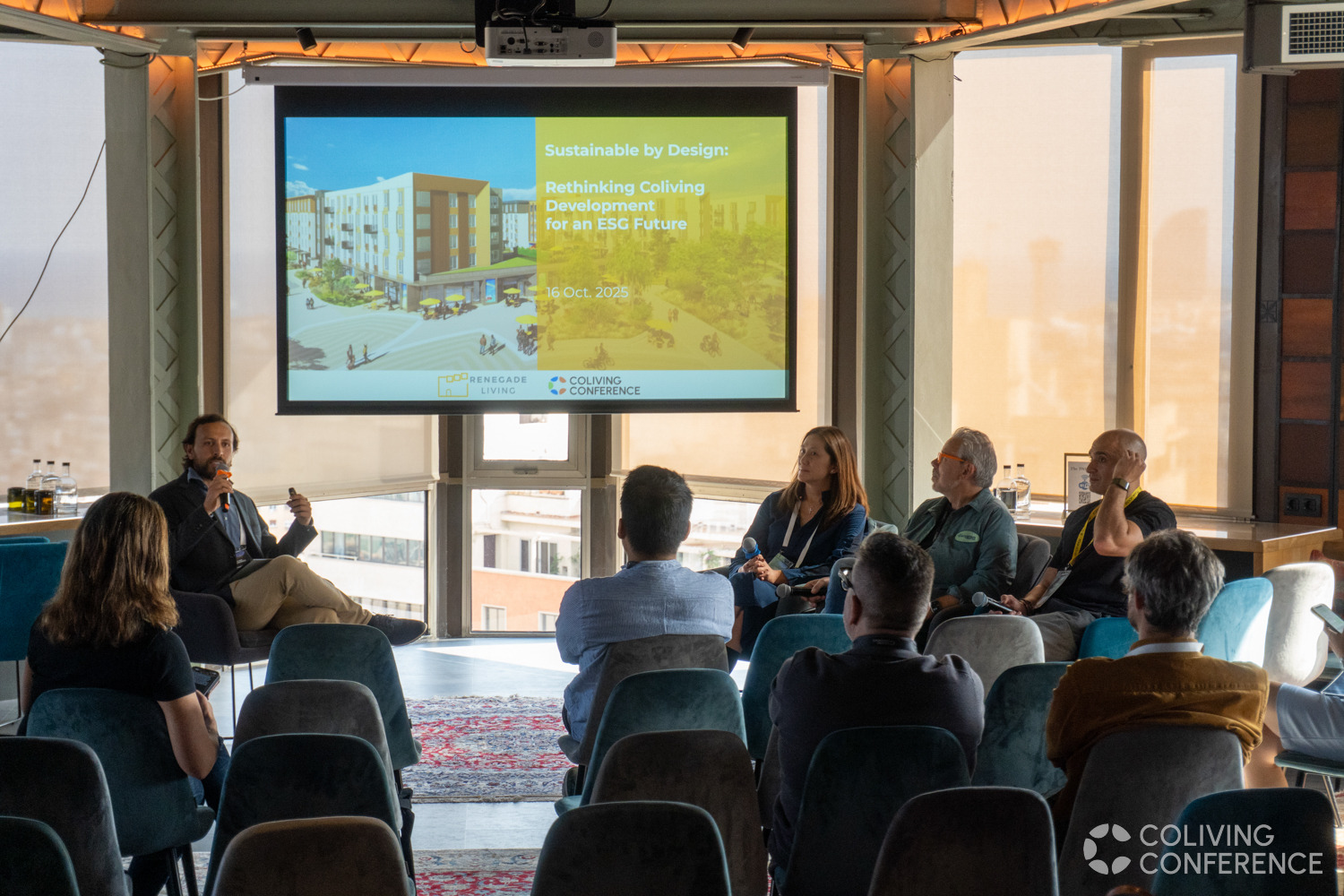
The Coliving Conference 2025 featured a thought-provoking panel discussion on how can coliving design integrate ESG principles, tackle embodied carbon, and unlock affordable housing, moderated by Santiago Ossa. Panelists included Yimei Chan, Robert Barnard, and Yianni Tsitouras. The session covered how a new generation of coliving developments is emerging that aligns environmental goals, adaptive reuse, and community impact within a single, scalable vision.
The real estate sector currently sits at the crossroads of three distinct but overlapping crises - housing shortages that have priced an entire generation out of city centres, a loneliness epidemic that is silently eroding public health, and a climate emergency where the built environment remains one of the largest contributors to global carbon emissions. For years, developers viewed these as separate fires to be fought with separate hoses. However, a maturing coliving sector is beginning to demonstrate that these challenges are actually interconnected opportunities. By treating Environmental, Social, and Governance (ESG) criteria not as a compliance burden but as a blueprint for innovation, forward-thinking operators are finding that the most sustainable buildings are also the most profitable.
The consensus from Coliving Conference 2025 in Barcelona, Spain, was that the era of vague greenwashing is over. In its place is a rigorous, data-backed approach where carbon reduction finances affordability, and community engagement secures planning permissions.
Is ESG a Compliance Burden or a Competitive Advantage?
For a long time, the argument for sustainable development was framed almost exclusively in moral terms. While the moral imperative remains urgent, the economic case has arguably become the stronger driver for adoption. There is growing evidence that assets adhering to strict environmental and social standards hold their value better over time. Santiago Ossa, Founder at Renegade Living, pointed to research from the University of Denver indicating that real estate funds voluntarily reporting ESG metrics outperformed their peers by 124 basis points.
This financial viability is most visible in the surge of adaptive reuse projects. Rather than demolishing existing structures for purpose-built assets - a process heavy in upfront capital and carbon emissions - operators are finding immense value in the existing structure of the city. Robert Barnard, Co-Founder at Toboggan Flats, has built a model based on converting vacant office space into housing for young adults. In the Canadian market, where office vacancy rates remain high post-pandemic, this strategy solves a dual problem for municipalities by revitalising deserted business districts, while supplying critical housing stock.
The economic argument for conversion is compelling. Barnard notes that a retrofit can reduce the timeline from conception to move-in to as little as nine months, a fraction of the time required for new builds. By reusing existing plumbing and electrical infrastructure, developers can significantly cut costs from the construction budget. These savings are not merely retained as profit, but are necessary to deliver the lower rents that young tenants desperately need. In this context, environmental reuse directly unlocks social affordability.
Building Less to Achieve More
The industry is increasingly distinguishing between operational carbon, which is the energy a building uses day-to-day, and embodied carbon, which is the energy consumed to create the materials and construct the building. As operational efficiency improves through better insulation and smart systems, embodied carbon becomes a bigger percentage of emissions.
Yianni Tsitouras, CEO at POHA House, advocates for a radical approach to material use that goes beyond simple recycling, championing the concept of Cradle-to-Cradle design in the residential sector. In their Moringa project in Hamburg, the building is designed as a material bank. Components are catalogued in a material passport, ensuring that at the end of the building’s life, they can be disassembled and reused rather than demolished and sent to a landfill.
This philosophy of “urban mining” turns waste streams into supply chains. Tsitouras detailed how countertops in their Preuswald location were reclaimed from a bank in Frankfurt, and how 95% of the building’s structure was reused. This supports a narrative shift as well, as the modern tenant is more engaged with the story of a building that repurposes ocean-bound plastic, for example. However, Yimei Chan, Co-Founder & Design Director at LOD, offers a necessary counterpoint to the focus on materials. She argues that “the most sustainable building is the one you do not have to build at all.” LOD emphasises a “build less” philosophy, using data to design flexible spaces that can evolve with the demographic shifts of their residents. By understanding the granular needs of users - whether they are Gen Z digital nomads, or an ageing population in an intergenerational setup - designers can avoid the hassle of over-specification.
The Architecture of Connection and Affordability
The risk for the coliving sector has always been the commodification of community, where social value is reduced to movie night in the common room. If the environmental aspect of ESG is about the physical building, the social aspect is the operating system. The next generation of operators is moving towards a model of deep integration with the surrounding neighbourhood.
Municipalities are often wary of coliving developments, fearing they will become “transient islands” that do not contribute to the local fabric. Tsitouras noted that in cities like Hamburg, access to prime sites was only granted because the operator could demonstrate a tangible plan to connect residents with the local community. This involves community managers who act as bridges, connecting residents with local doctors, businesses, and social enterprises. By offering space to local brands and engaging in neighbourhood urban gardening projects, the building becomes a hub rather than a fortress.
However, social impact must be grounded in the economic reality of the tenant. Barnard highlights a troubling trend where young people’s concern for the environment is being overshadowed by anxiety over basic affordability. In Canada, where 70% of young people cannot afford current housing rates, the best social good a developer can provide is lower rent. This requires difficult conversations and trade-offs. Barnard describes involving potential residents in the design process, asking them to choose between luxury features like private ensuite bathrooms or significant rent reductions achieved through high-quality shared facilities. When presented with the math, the preference often swings towards affordability. This participatory approach ensures that the “Social” in ESG is defined by the users themselves, not imposed by a developer’s assumptions.
Aligning Private Capital with Public Needs
The governance piece of the ESG puzzle is perhaps the most complex, requiring a realignment of the relationship between private operators and public authorities. The coliving sector is still misunderstood by many city planners who lack a clear regulatory box in which to place it. This is why education has become a core responsibility for development teams, explaining that coliving is a viable solution to the stagnation of secondary cities and the housing crisis.
There are signs that this persistence is paying off. In Calgary, Canada, the municipal government has introduced an incentive of roughly $ 60 per square foot for office-to-residential conversions, explicitly including coliving in the criteria. This policy innovation acknowledges that the private sector needs financial de-risking to tackle the complex engineering challenges of adaptive reuse.
Furthermore, the integration of technology is enabling better governance and transparency. Chan’s work at LOD utilises big data and AI to track user behaviour and optimise community design. This data-driven approach moves the industry away from intuition and towards quantifiable metrics of well-being and usage. When an operator can prove to a city council or an investor exactly how a space is performing socially and environmentally, the conversation shifts from subjective opinion to objective fact. This transparency is crucial for unlocking green financing, which Tsitouras points out is becoming an essential tool for moving sustainable projects towards financial viability.
Beyond the Greenwashing Trap

There is a fine line between genuine impact and marketing fluff. As the sector matures, it faces the danger of performative sustainability. Residents are quick to spot inauthenticity. “A fermentation workshop that nobody attends is not social impact; it is just wasted budget”, remarked Tsitouras. True engagement requires meeting residents where they are, and designing sustainability that is effortless and enjoyable.
The future of coliving relies on a holistic view where the environment, the community, and the bottom line are mutually reinforcing. There is now an emergence of buildings that are 80% demountable, operational models that act as carbon sinks, and financial structures that reward social inclusion.
Redefining Value Through Circularity and Connection
As the industry matures, the distinction between "sustainable" and "standard" coliving is rapidly evaporating. The most successful operators will be those who understand that they are not just in the business of renting rooms, but in the business of curating resilient ecosystems.
First, the priority must be on the retention of existing structures. The carbon savings of adaptive reuse are immediate and massive, and the associated speed of delivery addresses the urgent cash-flow needs of investors and the housing needs of tenants. Second, the boundaries of the coliving asset must dissolve. The success of a building should be measured by its porosity, and how well it integrates with local businesses, healthcare systems, and social enterprises. Finally, affordability must be re-framed as a core tenet of sustainability - a green building that displaces its demographic is a failure of governance. By aligning the physical durability of materials with the social durability of affordable rents, coliving can secure its place as the housing model for a resource-constrained future.