


Creating Working & Living Hubs for Hybrid Lifestyles
The Coliving Conference 2025 featured a thought-provoking panel discussion on how coliving brands deliver affordable luxury amidst rising costs, moderated by Moyra Marval. Panelists included David Uriarte and Artūras Pitkauskas. The session focused on how the lines between residential and professional environments are becoming increasingly blurred as the workforce of today becomes more diverse. As the demand increases for spaces that are adaptable, connected, and conducive to both personal well-being and professional growth, developers and operators are now designing ecosystems that combine residential comfort with the flexibility of dynamic workspaces.
Log in or Become a member
Coliving is often sold as a lifestyle, but operators are increasingly describing it as infrastructure for a labour market that no longer fits a 9-5 office routine. When we view coliving as part of tomorrow’s employment landscape, the practical implications become clear. If hybrid work is here to stay, then the question is not whether buildings include desks, but whether the entire service model anticipates that residents will live, work, and socialise within the same ecosystem. Insights shared at Coliving Conference 2025 in Barcelona, Spain, suggest that the next phase of shared living will be dictated less by aesthetics and more by operating choices that allow residents to incorporate both work and play.
How hybrid living is becoming an operational model
Moyra Marval, Professor of Strategy & Entrepreneurship at NEOMA Business School suggested that what separates coliving from hotels and conventional apartments is not simply design, but the length and purpose of stay. The easiest way to understand coliving’s commercial role is to then treat it as a time-based product that sits between these two established categories.
A time-based lens also clarifies why debates about pricing keep returning to value decay. David Uriarte, CEO & Co-Founder at Aticco Living in Barcelona, Spain, who moved from consulting to hospitality, argued that the customer service that feels indispensable in the first weeks becomes less valuable after several months, because residents learn the city, build friendships, and become capable of optimising their own living set-up. For decision-makers, this is more than a positioning statement, because it shapes product design and revenue assumptions. If the “peak value” period is front-loaded, then retention strategies, amenity investments, and even staffing models should be adjusted to a customer journey where the perceived benefit may decrease over time.
Balancing ‘home’ and ‘hustle’ in the same building
What happens when the workplace moves under the same roof? Often presented as a lifestyle upgrade, integrating coworking into residential assets highlights a more operational reality. Uriarte made the case that coliving and coworking are structurally different businesses, with coworking targeting business-to-business and coliving targeting business-to-consumer, which in turn changes how sales cycles, price sensitivity, and service expectations play out.
By contrast, Artūras Pitkauskas, CEO at Youston Living described his company’s approach as integrated across several European markets, operating sites in Vilnius, Prague, Riga, and starting a reconstruction project in London planned to open next year. With coworking areas embedded in buildings that combine student housing and coliving, it stands alongside amenities such as saunas, cinema rooms, and playrooms. However, integration is a spectrum - some of Youston’s coworking areas are open to the public when the demand is large enough, while smaller coworking areas in other cities are reserved for residents. However, there is a tradeoff - opening coworking to the public can improve utilisation and commercial payoff, while introducing security and quality-control pressures. It can also unsettle residents who want the building to feel like a home.
Design decisions also get quantified when work is part of the offer. Uriarte explained that Aticco designs for homes rather than hotels, even down to choices like not putting numbers on doors, to avoid the feel of a hotel corridor. In this sense, bringing external visitors into living areas may undermine the sense of domestic calm, even if most residents in a highly international environment might tolerate it.
When asked what proportion of space should be coworking within a mixed-use building, Pitkauskas gave a rule of thumb of 0,3 m2 - 0,5 m2 per room, describing it as small but sufficient - and not overcrowded based on experience. Even if the number is not universal, it illustrates a shift in mindset. Coworking is no longer an optional add-on, but a resource that complements other revenue-generating or experience-shaping spaces. The goal is not to replicate an office, but to provide just enough functional space to keep residents productive. For developers and architects, this pushes the conversation away from generic amenity checklists and towards evidence-led sizing, access rules, and acoustic separation that reflect who the building is truly for.
Community as infrastructure
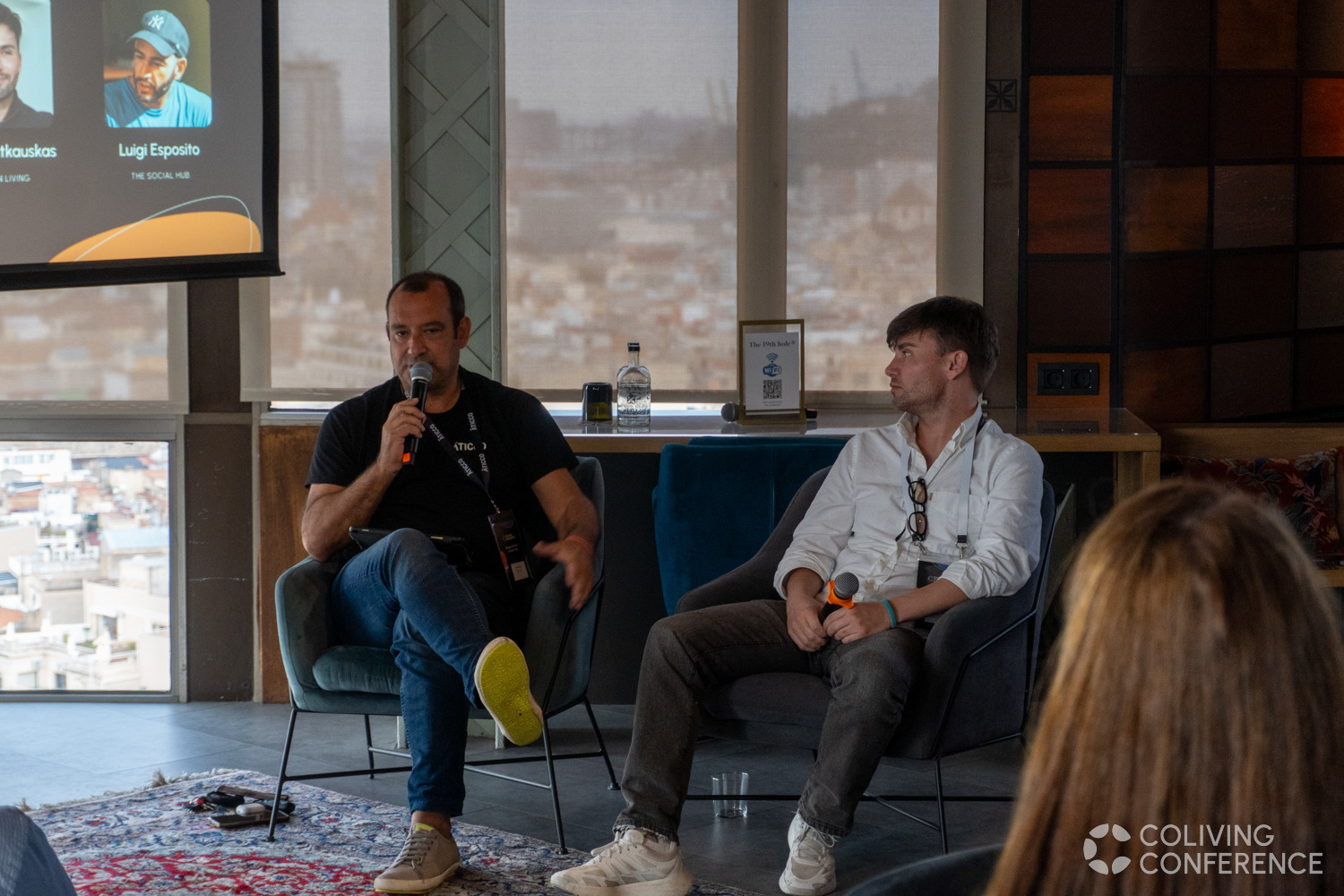
One of the biggest distinctions of coliving is that community is increasingly treated as infrastructure rather than programming. Uriarte described Aticco as an ecosystem that spans coworking, coliving, events, and a startup accelerator, and linked growth to the deliberate layering of real estate, design, community, and brand. His description of Aticco’s scale, including 60.000 m2 under management, a community of around 7,000 people, more than 700 events per year, and a coliving portfolio of roughly 600 units in Spain, positions “community” not as a soft benefit but as an foundational operating asset. In fact, Uriarte explained that some of the highest-value moments happen outside the building - particularly in external spaces in good weather - which reframes placemaking as something that extends beyond the boundaries of the building.
Pitkauskas pushed the same principle further, describing a resident ambassador approach where community members take on responsibilities that might otherwise sit with staff, from organising events to introducing new residents to the property. When residents host the experience, the building feels owned by the community, which can reinforce norms and reduce the management burden through informal “policing” of shared spaces. However, it is important to note that cohesion can be compromised in buildings that bring together students and young professionals with different rhythms, noise tolerances, and expectations of privacy. Pitkauskas was direct about the limits, suggesting it is “impossible to satisfy everyone”, which is a useful reminder for operators who overpromise universal harmony.
Technology reduces friction
Alongside social operating systems, technology can absorb friction that community cannot. Pitkauskas described a project that applies artificial intelligence to camera systems so that unusual events can automatically trigger notifications to a security company, with the explicit aim of reducing operational costs. In an integrated building that may include public-access coworking, that kind of automation is not a futuristic add-on, but a practical method to protect resident trust without staffing every risk scenario. The broader implication is that as coliving expands into more mixed-use configurations, “security” becomes a brand promise that needs investment, measurement, and continual refinement.
Capital chooses its operating model
Expansion strategy in coliving is often described in terms of ambition, yet the transcript shows that the real differentiator is the operating model that capital is willing to back. Uriarte described Aticco as asset-light, explaining that the company did not own its assets and instead built credibility gradually, moving from small landlords to family offices and then towards larger institutional conversations as its track record matured. That pathway matters because many cities still treat coliving as a new or hard-to-classify product, which can make underwriting conservative and development timelines long, and it rewards operators who can prove demand, brand pull, and execution capacity without tying up balance sheet capital.
Youston’s approach sits at the opposite end, with Pitkauskas stating that the company owns its buildings, maintains teams that source property in European capitals, and separately engages investors, positioning the platform as both an operator and an investment-facing business. He also referenced the value of receiving the Operator of the Year (Scale-Up) award at the Coliving Awards as a mechanism to attract further capital, highlighting how reputation signals function as financing tools in a market where benchmarks are still emerging. For investors comparing models, the key question becomes less about which structure is “better” and more about which risks they prefer to hold, whether that is operational execution in an asset-light model or development and capital deployment in an owned-asset model.
Finding a Middle Ground: Timing and Pricing
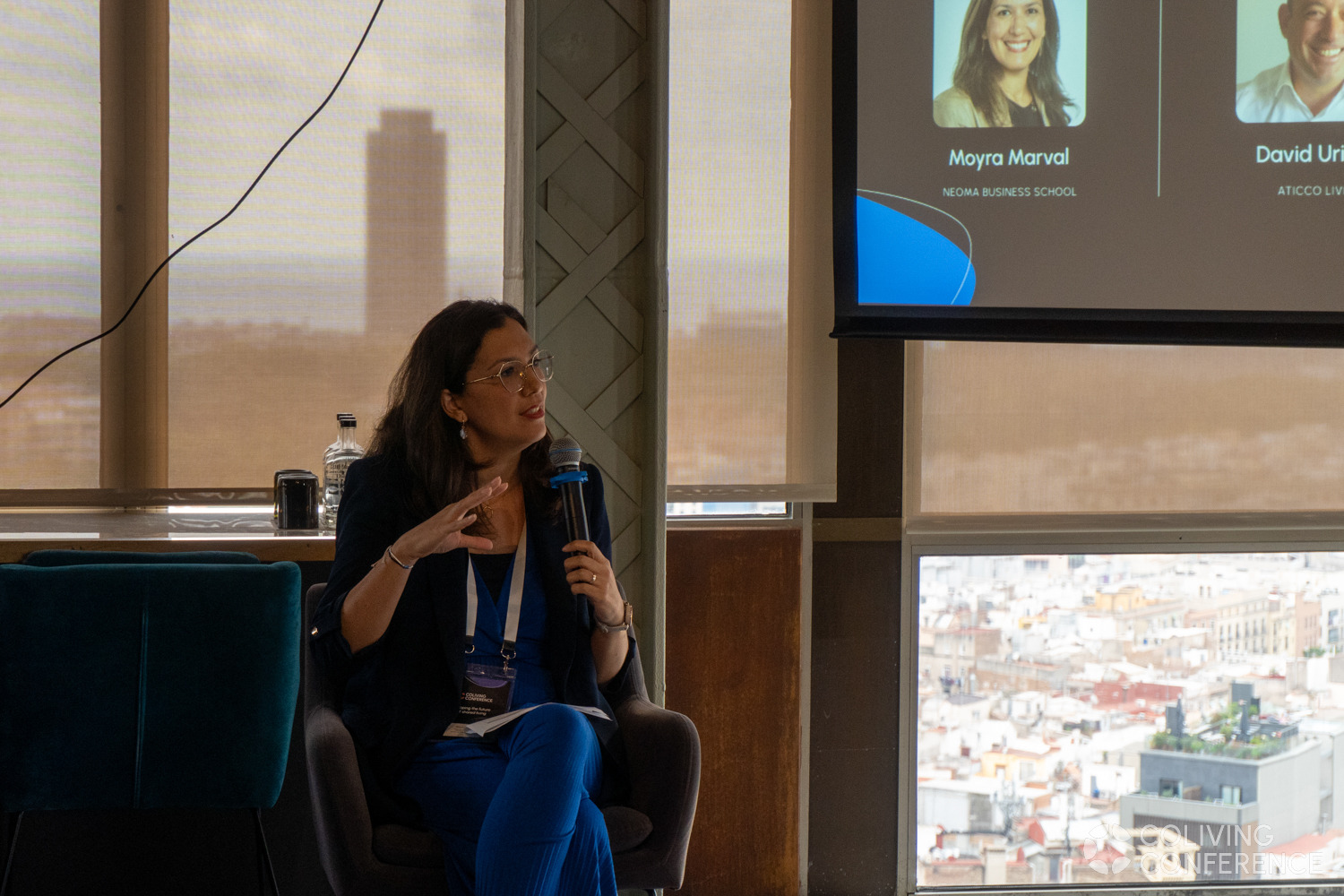
The most strategically consequential theme may have been timing. Marval summarised the positioning neatly - what separates hotels, apartments, and coliving is often time. A four-day trip to Barcelona favours a hotel, a four-year degree favours a long-term apartment, but five to six months sits in the awkward middle where traditional landlords do not cater to short stays and hotels become excessively expensive. Coliving fits neatly in that gap, which suggests that operators should treat length of stay as a product feature.
Uriarte pushed the argument further by explaining that, at least for Aticco, coliving is inherently temporal. In his view, the operator provides enormous value in the first few weeks, but after six months the value declines as residents become familiar with the city, understand how to navigate utilities and services, and can arrange housing on their own. However, this should not be taken as a critique of coliving, but an opportunity for operators to understand where value is created over time. It also suggests why operators struggle with long-term retention without either lowering service costs through technology or deepening the professional and social network effects that remain valuable beyond the initial settling-in period.
The strongest industry warning embedded in the conversation is that economic disruptions can rapidly reshape demand, affordability, and unit economics. Pitkauskas argued that Europe’s recent experience, including the displacement effects following Russia’s invasion of Ukraine and the ongoing arrival of refugees, has materially affected housing markets, and he cited examples of sharp price increases in Vilnius, where monthly prices he referenced moved from roughly € 400 to nearly € 800 over three years, and in Prague, where figures moved from approximately € 780 to € 1.000 euros per month. He linked these dynamics to a belief that private living space may shrink further as affordability pressures rise, implying that coliving operators will be forced to create dignity, functionality, and community in smaller footprints than many current models assume.
Pitkauskas described how a newly opened building filled within weeks during the early phase of the war-driven demand spike and noted that government support helped cover housing costs for around 100 Ukrainian refugees living in their buildings, which is a reminder that coliving can intersect with public policy in ways that operators must navigate carefully. In parallel, Uriarte’s view that coliving is fundamentally temporary suggests a strategic discipline - the sector grows by solving the “in-between” problem for people who are relocating, studying for a defined period, or arriving for projects, rather than by competing head-on with long-term rental housing.
What Coliving Learns When Work Moves In
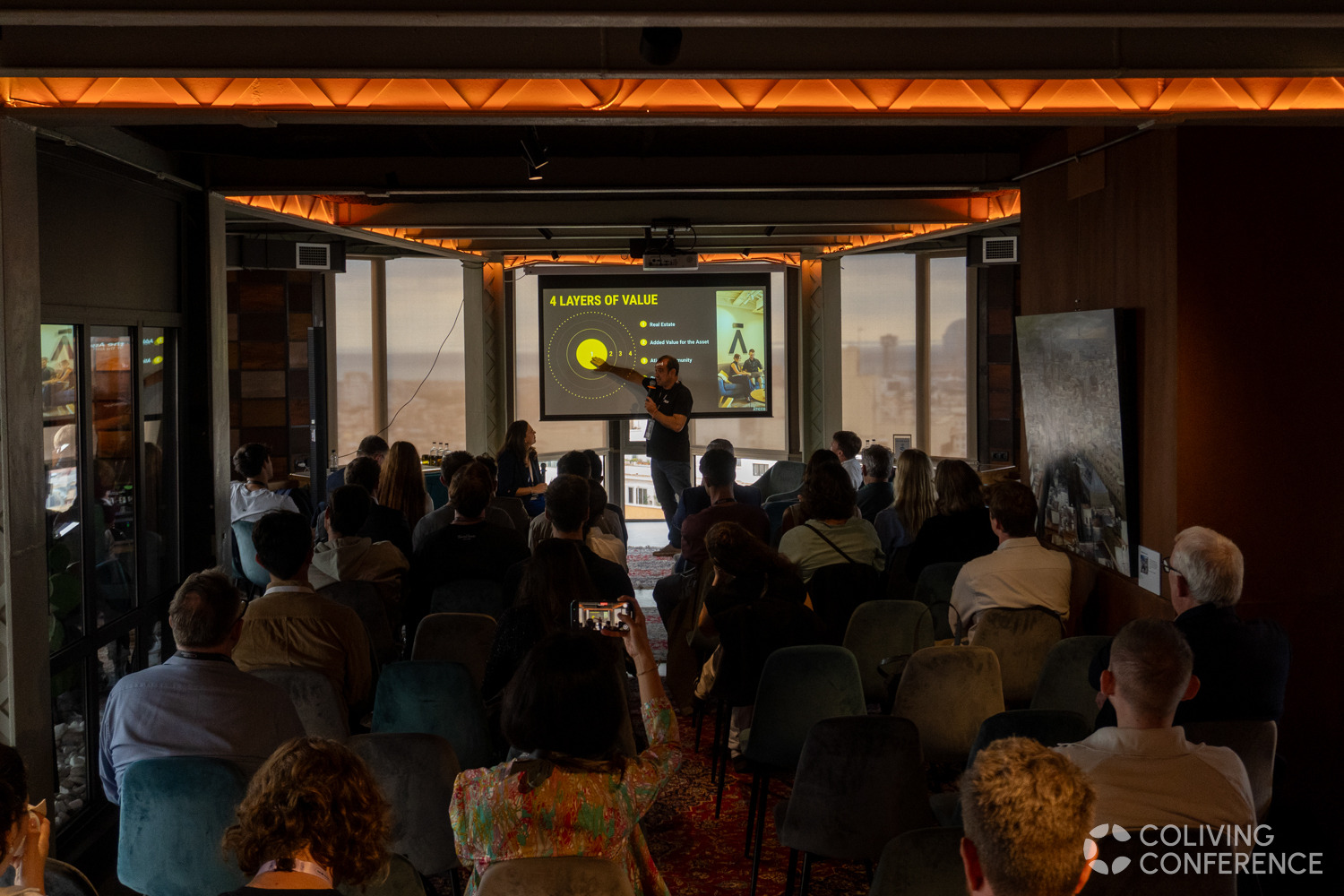
Since value seems to be highest at the start of the stay, operators should invest in frictionless move-in, immediate social connection, and work-ready routines, while designing offboarding pathways that keep alumni tied to the brand through events, memberships, or referrals rather than forcing longer retention at any cost. If integrated coworking increases both opportunity and risk, developers should determine early whether coworking is resident-only or public-facing, before aligning circulation, staffing, and technology accordingly. With community solidifying itself as infrastructure, formalising ambassador models and resident-led programming in a way that protects authenticity to foster cohesion in mixed cohorts of students and young professionals. And if expansion is ultimately shaped by capital structure, founders can choose whether to scale through track record and partnerships, as Aticco described, or through ownership and investor-facing services, as Youston described, while being honest about which capabilities their teams can reliably execute.
In the end, the opportunity for hybrid lifestyles is not merely adding a coworking room to a residential building. Instead, the shift forces operators, investors, and developers to decide what “home” should feel like when professional life is always nearby, and how much friction the operating model can absorb before community turns into churn. Above all, time should be treated as the organising variable, which means the most resilient coliving strategies may be those that price, staff, and design around the reality that residents’ needs change sharply between day one and month six, and that in a volatile Europe, demand will keep arriving from places operators cannot predict.


